Point Conversion Calculation
The Point Conversion tool allows single-point calculations of numeric coordinates.
This page describes the Point Conversion Calculation; see also: Forward and Inverse calculations.
Compare Conversion, Forward, and Inverse Calculations
Geographic Calculator Cloud's Point and Point File Calculation tools have three different file translations that can be performed: Conversion, Forward, and Inverse. This page describes the Conversion Calculation; the others can be found on their respective pages.
-
Conversion converts or transforms coordinates between coordinate reference systems.
-
Forward calculation is used to compute a new coordinate that is a given distance and azimuth away from a starting coordinate. Forward calculations follow one of three paths: Geodesic (Great Circle), Rhumb Line (Constant Azimuth), or Grid (valid for projected coordinates only). Both the source and destination points must be referenced to the same geodetic base coordinate system.
-
Inverse calculation computes the distance between two known coordinates on the same datum. The result may be calculated using Geodesic, Rhumb, or Grid (valid for projected coordinates only) calculation methods. Both the source and destination points must be referenced to the same geodetic base coordinate system.
Conversion Calculation Requirements
Setting up a Conversion Operation requires:
- A Source Coordinate and its Coordinate System
- Specified Target Coordinate System
- Specified Transformation
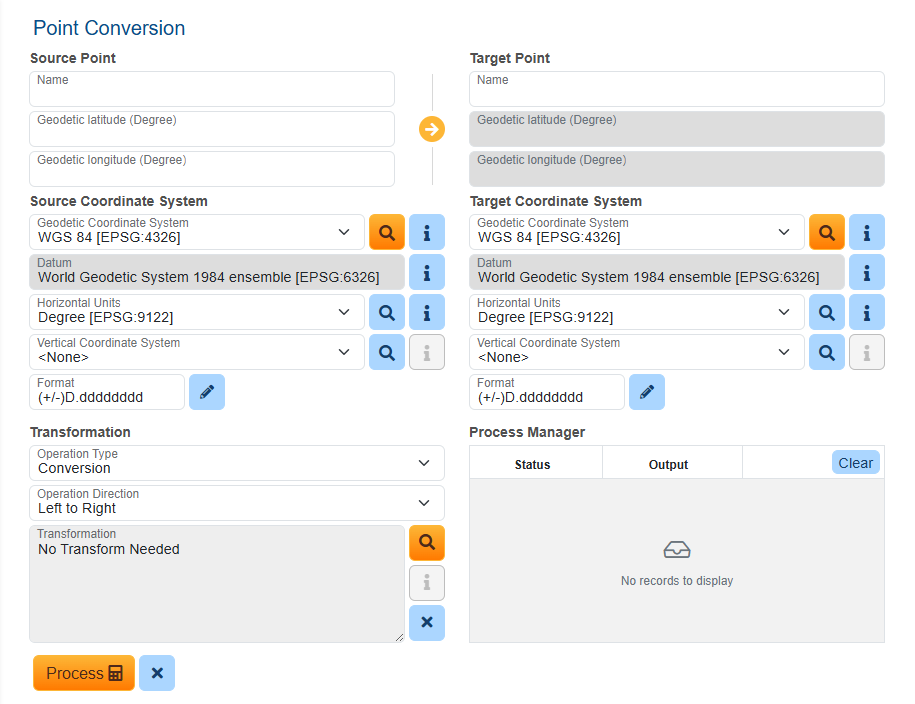
How to set up the Point Conversion Operation:
Enter a coordinate, select source and target systems, and select a transformation to convert the source point to the new coordinate system.
- Under Source Point, enter a name (optional) and the coordinates for the source point.
- Under Source Coordinate System, select the coordinate system that corresponds to the coordinate to be converted.
Use
 to search the Datasource. The Select Source System dialog will display, and you may narrow the search by entering a search string into the Search field or browse the Coordinate Systems folders. Use the i icon to see information on each CRS. For more information on choosing a Coordinate Reference System (CRS), see the Datasource Search.
The default Source Coordinate System is WGS 84 [EPSG:4326], but recently used coordinate systems will populate the Source Coordinate System dropdown.
- The units for the source and target systems will be automatically populated with the units defined in the selected objects. You may optionally use to search for and change the source or target units.
- The units for the source and target systems will be automatically populated with the units defined in the selected objects. You may optionally use
- To perform a vertical transformation, additionally set the source Vertical Coordinate System. Use to search the Datasource and select a vertical CRS.
- Once a Vertical Coordinate System has been chosen, the option to input the source point height (elevation) value will appear. The vertical unit can be changed if necessary.
- Format and precision options can be accessed by using
 to launch the Select Format dialog.
  Supported Formats include:
Latitude and longitude accept various input formats beyond decimal degrees. The formats that you can select are shown below with an example (all examples represent the coordinate: South 44 degrees, 30 minutes, 15 seconds):
DD. (example: -44.50416 or 44.50416 S)
DD MM. (example: -44 30.2500 or 44 30.2500 S)
DD-MM. (example: -44-30.2500 or 44-30.2500 S)
DD MM SS. (example: -44 30 15.000 or 44 30 15.000 S)
DD-MM-SS. (example: -44-30-15.000 or 44-30-15.000 S)
DD.MM (example: -44.3025 or 44.3025 S)
DD.MMSS (example: -44.3015 or 44.3015 S)
Packed DMS (example: -44301500 or 44301500S)
Packed DMS. (example: -443015.00 or 443015.00S)
Packed DM. (example: -4430.2500 or 4430.2500S)
Brazil ANP (example: -44:30:15,000)
The direction (N/S/E/W) can be entered as either a prefix or suffix.
- Set the Target Coordinate System using the same steps as above.
- The Date field will display if time-dependent transformations are enabled in Settings. Source and Target dates are required for time-dependent transforms to display in the transformation selection choices..
-
If the Source and Target Coordinate Systems are defined on different datums, use the Choose Transformation field to search the Datasource and select a valid transformation. If no transformation is needed, a message stating this will appear in the display box. If no valid transformations are found between the two datums, the Coordinate Transformation box will display "No Choices". A null transformation "<None>" can be selected by enabling the setting "Allow null transformations ("<None>" option).
Use the Search field in the Select Transformation dialog window to limit the results by text string or expand the folders on the left side to select the transformation. The transformations are limited by Source and Target CRS selections (and input coordinate range if AOU filtering is enabled in settings).
-
The Datasource Transformations folder will contain any predefined objects organized into subfolders by transformation type (Concatenated, Datum, and Parametric).
-
The Generated Transformations folder will contain any on-the-fly concatenated transformations organized into subfolders based on the intermediate datums.
Click on the desired transformation’s name to select it. The Select Transformation dialog window will close automatically and the selected transformation will be shown, in addition to any Vertical Transformation that is selected.
-
- Click Process to convert the point and populate the Target Point definition fields.
Note: The Source and Target fields can be reversed using the arrow button. This reverses the Operation Direction (left-to-right versus right-to-left). The arrow will reverse to indicate the direction.